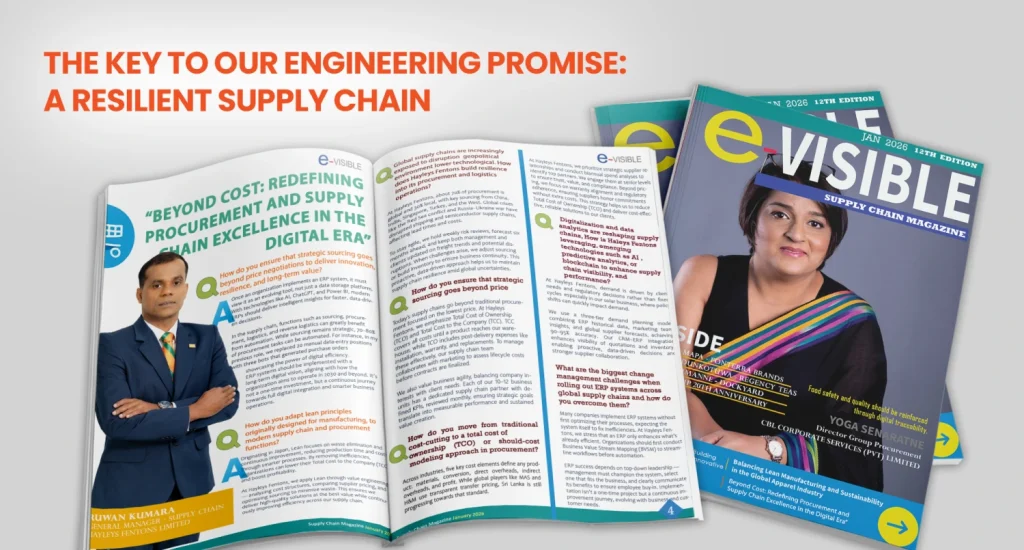
RUWAN KUMARA GENERAL MANAGER – SUPPLY CHAIN HAYLEYS FENTONS LIMITED
Q: How do you ensure that strategic sourcing goes beyond price negotiations to deliver innovation, resilience, and long-term value?
A: Once an organization implements an ERP system, it must view it as an evolving tool, not just a data storage platform. With technologies like AI, ChatGPT, and Power BI, modern ERPs should deliver intelligent insights for faster, data-driven decisions.
In the supply chain, functions such as sourcing, procurement, logistics, and reverse logistics can greatly benefit from automation. While sourcing remains strategic, 70–80% of procurement tasks can be automated. For instance, in my previous role, we replaced 20 manual data-entry positions with three bots that generated purchase orders showcasing the power of digital efficiency. ERP systems should be implemented with a long-term digital vision, aligning with how the organization aims to operate in 2030 and beyond. It’s not a one-time investment, but a continuous journey towards full digital integration and smarter business operations.
Q: How do you adapt lean principles originally designed for manufacturing, to modern supply chain and procurement functions?
A: Originating in Japan, Lean focuses on waste elimination and continuous improvement, reducing production time and costs through smarter processes. By removing inefficiencies, organizations can lower their Total Cost to the Company (TCC) and boost profitability.
At Hayleys Fentons, we apply Lean through value engineering — analyzing cost structures, comparing supplier pricing, and optimizing sourcing to minimize waste. This ensures we deliver high-quality solutions at the best value while continuously improving efficiency across our supply chain.
Q: Global supply chains are increasingly exposed to disruption geopolitical environment lower technological. How does Hayleys Fentons build resilience into its procurement and logistics operations?
A: At Hayleys Fentons, about 70% of procurement is global and 30% local, with key sourcing from China, India, Singapore, Turkey, and the West. Global crises like the Red Sea conflict and Russia–Ukraine war have disrupted shipping and semiconductor supply chains, affecting lead times and costs.
To stay agile, we hold weekly risk reviews, forecast six months ahead, and keep both management and clients updated on freight trends and potential disruptions. When challenges arise, we adjust sourcing or build inventory to ensure business continuity. This proactive, data-driven approach helps us to maintain supply chain resilience amid global uncertainties.
Q: How do you ensure that strategic sourcing goes beyond price?
A: Today’s supply chains go beyond traditional procurement focused on the lowest price. At Hayleys Fentons, we emphasize Total Cost of Ownership (TCO) and Total Cost to the Company (TCC). TCC covers all costs until a product reaches our warehouse, while TCO includes post-delivery expenses like installation, warranty, and replacements. To manage these effectively, our supply chain team collaborates with marketing to assess lifecycle costs before contracts are finalized.
We also value business agility, balancing company interests with client needs. Each of our 10–12 business units has a dedicated supply chain partner with defined KPIs, reviewed monthly, ensuring strategic goals translate into measurable performance and sustained value creation.
Q: How do you move from traditional cost-cutting to a total cost of ownership (TCO) or should-cost modeling approach in procurement?
A: Across industries, five key cost elements define any product: materials, conversion, direct overheads, indirect overheads, and profit. While global players like MAS and H&M use transparent transfer pricing, Sri Lanka is still progressing towards that standard.
At Hayleys Fentons, we prioritize strategic supplier relationships and conduct biannual spend analyses to identify top partners. We engage them at senior levels to ensure trust, value, and compliance. Beyond pricing, we focus on warranty alignment and regulatory adherence, ensuring suppliers honor commitments without extra costs. This strategy helps us to reduce Total Cost of Ownership (TCO) and deliver cost-effective, reliable solutions to our clients.
Q: Digitalization and data analytics are reshaping supply chains, How is Hayleys Fentons leveraging, emerging technologies such as AI, predictive analytics, or blockchain to enhance supply chain visibility, and performance?
A: At Hayleys Fentons, demand is driven by client needs and regulatory decisions rather than fixed cycles especially in our solar business, where policy shifts can quickly impact demand.
We use a three-tier demand planning model combining ERP historical data, marketing team insights, and global supplier forecasts, achieving 90–95% accuracy. Our CRM–ERP integration enhances visibility of quotations and inventory, enabling proactive, data-driven decisions and stronger supplier collaboration.
Q: What are the biggest change management challenges when rolling out ERP systems across global supply chains and how do you overcome them?
A: Many companies implement ERP systems without first optimizing their processes, expecting the system itself to fix inefficiencies. At Hayleys Fentons, we stress that an ERP only enhances what’s already efficient. Organizations should first conduct Business Value Stream Mapping (BVSM) to streamline workflows before automation.
ERP success depends on top-down leadership — management must champion the system, select one that fits the business, and clearly communicate its benefits to ensure employee buy-in. Implementation isn’t a one-time project but a continuous improvement journey, evolving with business and customer needs.
Supply Chain Magazine – 2026